Boyarsky Restaurant
A Gentleman in MoscowBoyarsky Restaurant, tucked into the northeast corner of the Metropol’s second floor, is at once one of Moscow’s most prestigious dining rooms and a working world governed by precision. Its vaulted ceilings, dark red walls, polished service, and resourceful kitchen make it a place where ceremony survives scarcity and political upheaval. Under Andrey Duras’s direction and Emile Zhukovsky’s knife, the restaurant’s excellence depends not simply on what can be served, but on how carefully people and routines are arranged.
Setting and Reputation
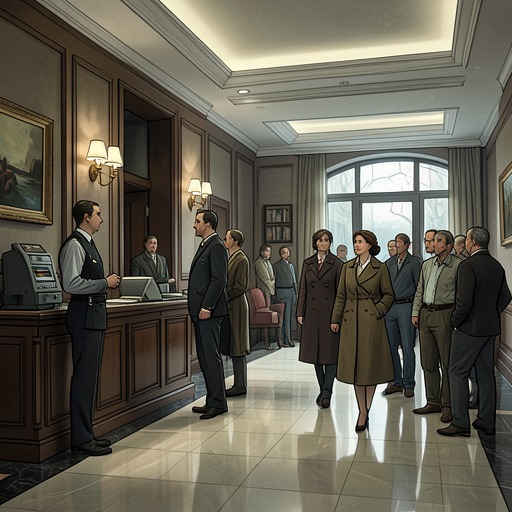
Before the upheavals of 1920, Boyarsky Restaurant was described as the finest restaurant in Moscow, perhaps in all of Russia. Its décor suggested a boyar’s retreat; its waitstaff were regarded as the city’s most sophisticated, and its chef as subtle. The experience began before anyone reached a table. Hopeful diners crowded around Andrey as he presided over a large black reservation book, and even those admitted might be stopped five times, in four languages, on the way to a corner table. There, a waiter in a white dinner jacket completed the performance of flawless service.
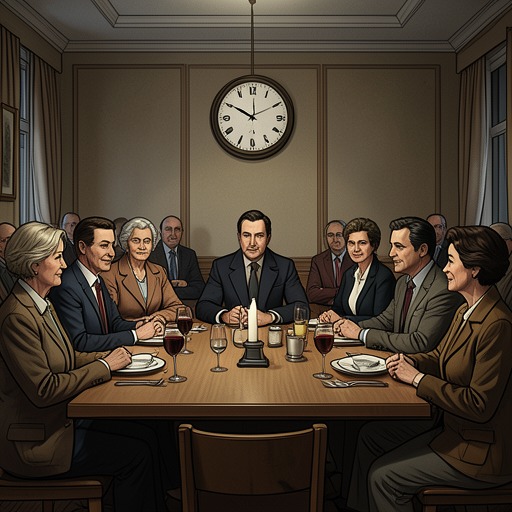
That carefully cultivated world was abruptly narrowed in 1920. After the Bolsheviks sealed the borders, they prohibited the use of rubles in fine restaurants, effectively excluding 99 percent of the population. Boyarsky Restaurant remained open to its small circle of diners, but its room no longer carried the bustle of its former reputation. As the Count ate, water glasses clinked against cutlery, couples whispered awkwardly, and even the best waiters found themselves staring at the ceiling. The contrast is not simply between abundance and scarcity: the restaurant’s ceremony persists, but the crowd and confidence that once gave it life have largely vanished.
A Kitchen Made for Scarcity
Emile Zhukovsky had been recruited to the Metropol in 1912 and given an experienced staff, a large kitchen, and a celebrated larder. That abundance, however, was a poor test of his talent. In the Revolution’s aftermath, economic decline, failed crops, and halted trade depleted the larder bushel by bushel, pound by pound, and dash by dash. Emile had to meet the expectations of diners with whatever could be found, including cornmeal, cauliflower, and cabbage.
His ingenuity is evident in a saltimbocca the Count finishes with pleasure. Instead of veal, Emile pounds flat a chicken breast; instead of Parma prosciutto, he shaves Ukrainian ham. For sage, he uses a soft, aromatic but more bitter herb. The Count recognizes nettle as the substitute, and Andrey confirms the guess. The altered dish makes deprivation tangible: it retains the form and ambition of a celebrated preparation while replacing its ingredients with what a constrained kitchen can obtain. Emile’s reputation rests on making scarcity itself a test of craft.
The kitchen remains a place of concentrated activity. At two o’clock, junior chefs chop carrots and onions while Stanislav, the sous-chef, debones pigeons; eight burners simmer sauces, soups, and stews, and the pastry chef takes trays of brioches from the oven. Emile stands at the center, watching his assistants with a chopping knife in hand. The knife, ten inches long and two inches wide at its base, serves as more than a tool: he uses it to skin a rabbit, zest a lemon, turn a pancake, stir soup, measure ingredients, and point out mistakes. The scene makes his authority visible as a conductor’s, but his baton is a practical blade that can move directly from correction to preparation.
Service as a Discipline
Andrey Duras is the person who ensures that the restaurant runs smoothly. Born in the south of France, tall and graying at the temples, he is distinguished above all by his unusually long, pale, well-manicured hands. Their work gives the room its choreography: he appears to draw several chairs back at once, shelters a guest’s lighter flame with his other hand, and recommends a wine with a slight extension of his index finger. Such gestures make service look effortless, though their precision implies continual attention.
The Count’s own nightly rounds extend that attention into a ritual of inspection. At 5:45, with five waiters at their stations, he circles all twenty tables, checking each setting, saltcellar, and vase. At table four he realigns a knife parallel to its fork; at table five he moves a water glass from the midnight position to one o’clock. He removes a wine glass marked by lipstick at table six and polishes soap spots from a spoon at table seven until the room is reflected in its silver. The comparison to a commander reviewing troops makes the point: in the Count’s practice, order is prepared in small details before service begins.
That ideal is challenged when a new written ordering procedure is introduced. A waiter is to write each order on a pad, pass it to a bookkeeper for entry in a ledger, and wait for a cooking slip to reach the kitchen. The kitchen records the order in its log; once the food is ready, a confirmation slip prompts the bookkeeper to issue a stamped receipt authorizing its retrieval. Only then can the waiter mark the dish as delivered. The procedure makes every movement accountable on paper, but at Boyarsky Restaurant it disrupts the personal attentiveness customers expect: they are accustomed to waiters making eye contact, answering questions, offering recommendations, and remembering preferences without taking their hands from behind their backs. When the system is put into practice, slips of paper circulate through the room and veal cutlets and asparagus arrive cold. Administrative order has displaced the timing that makes service work.
Rituals, Meetings, and Company
The restaurant is also a setting for habits that belong to particular relationships. The Count knows that Andrey is aware of his sweet tooth, so Andrey offers him plum tart with the restaurant’s compliments. The Count declines because he has another commitment that evening. Later, the restaurant becomes a familiar setting for the Count and Sofia: they study their menus by working backward from entrées to appetizers, place their orders, and look forward to the interval before the appetizers arrive because it is reserved for their game of Zut. The pause that can unsettle other diners becomes, for them, a shared ritual.
Boyarsky Restaurant also hosts the daily meeting attended by the Bishop and the restaurant’s senior figures. The Bishop begins attending in the summer of 1953; in April 1954 he moves the meeting from Emile’s office to his own because activity in the kitchen proves distracting. The change turns a practical decision into a small display of hierarchy. Three delicate French chairs are set in a tight row before the Bishop’s desk, making the maître d’, chef, and headwaiter look like schoolboys summoned before a principal. The Bishop squares the menu against the desk and reviews each item with his pencil, while the three men fidget beneath portraits of Stalin, Lenin, and Marx. A restaurant built around attentive hospitality thus contains another kind of service encounter: its own senior workers wait to be examined.
The Restaurant’s Changing World
The life of Boyarsky Restaurant is measured through both continuities and alterations. Its celebrated kitchen adapts to depleted supplies; its service depends on embodied skill even as a paperwork system threatens to make it mechanical; its dining room preserves elegant forms through political change. The entrance itself carries a trace of that instability. When the Count returns after being taken to the Kremlin, Andrey, the concierge Vasily, and Marina gather at his doorway with the bewilderment of people who had assumed he would not return. Their appearance links the restaurant’s staff to the wider hotel community and to the Count’s sudden disappearance and return.
These episodes do not leave Boyarsky Restaurant untouched by history, but they show how its people respond at the scale they can control: a dish remade from scarce ingredients, a glass shifted precisely into place, a recommendation offered without breaking the rhythm of service. Its refinement is therefore not merely a remnant of an earlier social order. It is a practice repeatedly reconstructed by those who cook, serve, inspect, and dine there.